
A call to action for Disaster Risk Reduction at the UN
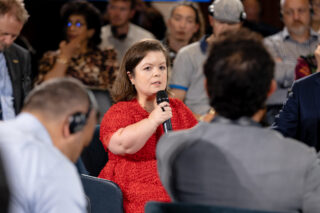
In early June 2025, Orla McCann and Sinéad Burke of the Tilting the Lens team went to the United Nations in Geneva, Switzerland for the Global Platform for Disaster Risk Reduction 2025. The conference is organised by the United Nations Office for Disaster Risk Reduction (UNDRR), who support countries and communities to lower risk and raise resilience in the face of natural and human-induced hazards.
They met with other mission-driven advocates, diplomats, and private sector companies, sharing insights on disability-inclusive strategies in climate emergencies, and learning about how governments and industries are designing more accessible infrastructure.
Orla McCann said, “The conference was an opportunity to learn from countries that have experienced consistent and continued catastrophic events. Locally, as well as globally, we can and should use risk mitigation as an opportunity to invest ahead of disaster. This investment should not only be financial but also in a people-led approach so that we don’t just build back better but build forward. We must leave no one behind. The goal is to create resilient communities, with better infrastructure, buildings and housing that will be a platform to enable Disabled people in particular to not only survive but to succeed and thrive.”
Call to Action
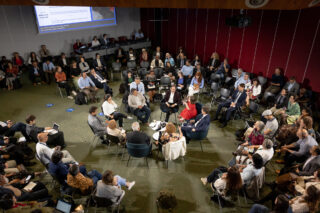
Sinéad Burke, Tilting the Lens CEO, spoke at the General Platform for Disaster Risk and Resilience in the discussion titled, “Infrastructure for a resilient, inclusive and sustainable future”.
She shared three rallying calls to action with the room:
- Make accessibility and disability inclusion non-negotiable criteria in DRR funding instruments — infrastructure bonds, climate finance, or Public Private Partnerships. We must also develop a toolkit to provide global guidance on what accessibility is and could be, rather than relying on local or regional legislation, which limits progress to compliance. If it’s not accessible, it’s not resilient — and it should not be funded.
- Embed disabled people in the governance of decision-making — at local, national, and multilateral levels. Advisory roles are not enough. Disabled people can be DPOs or OPDs, but we must also create the environments for them to be our government leaders, our development bank liaisons and private sector executives.
- Rethink how finance is distributed. Traditional top-down funding rarely reaches those most impacted, often because grant-making assumes levels of literacy and access. We must look to mutual aid models, participatory budgeting, and divestment from systems that exclude, to ensure that resources reach disabled people and other marginalised groups at the grassroots level — where resilience is often strongest, but least resourced.
You can read the full transcript of Sinéad’s speech below.
Full speech transcript by Sinéad Burke
Intervention by the Founder of Tilting the Lens at the General Platform for Disaster Risk and Resilience
My name is Sinéad Burke, I’m the founder and CEO of Tilting the Lens, an accessibility consultancy, in the private sector. We are not an NGO or a Disabled Persons Organization, we are a majority-disabled team whose work is rooted in cross-sector partnership—because resilience demands collective responsibility and accountability.
To engage with disaster risk reduction and truly ‘leave no one behind’, our approach must be intersectional. Intersectionality means recognising that no identity or community exists in a silo. Even within disability, disability can be visible or invisible, apparent and non-apparent. But, disabled people are women, trans people, elders, Indigenous, Queer, unhoused, displaced, and migrants—facing compounded risks in crisis and recovery. If our systems don’t account for this complexity, we will continue to design exclusions into our responses.
Despite progress in policy, disabled people remain disproportionately impacted by disasters—and are consistently underrepresented in the planning and recovery processes that follow.
This must change. Excellent disability-led organisations are undertaking critical work, but current frameworks limit inclusion to consultation or review. Building back better must translate into shared power and leadership.
From the most recent UNDRR Global Survey on Persons with Disabilities and Disasters:
In excess of 80% of respondents had no personal preparedness plan nor had they the opportunity to engage in community-level disaster risk reduction
This data is stark, but the framing continues to place the burden and responsibility for access on the individual, rather than the system.
In preparation for today, I am particularly grateful to Rebecca Cokley, Ford Foundation, Paul Timmons, Portlight Inclusive Disaster Strategies, and Paula Nolan, at Ireland’s Department of Foreign Affairs, for their insight into systemic solutions.
I offer three calls to action, directly linked to the Sendai Framework’s Priority 3: Investing in disaster risk reduction for resilience.
First, make accessibility and disability inclusion non-negotiable criteria in DRR funding instruments— infrastructure bonds, climate finance, or Public Private Partnerships. We must also develop a toolkit to provide global guidance on what accessibility is and could be, rather than relying on local or regional legislation, which limits progress to compliance.
If it’s not accessible, it’s not resilient—and it should not be funded.
Second, embed disabled people in the governance of decision-making—at local, national, and multilateral levels. Advisory roles are not enough. Disabled people can be DPOs or OPDs, but we must also create the environments for them to be our government leaders, our development bank liaisons and private sector executives.
Third, rethink how finance is distributed. Traditional top-down funding rarely reaches those most impacted, often because grant-making assumes levels of literacy and access. We must look to mutual aid models, participatory budgeting, and divestment from systems that exclude, to ensure that resources reach disabled people and other marginalised groups at the grassroots level—where resilience is often strongest, but least resourced.
Accessibility is not an act of generosity. It is a measure of good governance. Investing in lived experience develops essential intellectual property. If we want to meet the ambitions of the Sendai Framework, it must be built into every recovery and every dollar we invest.
Go raibh míle maith agaibh (Thank you)
Other Resources
Beyond function: a conversation on how alt-text becomes art
- Category:
- Past Events
- Webinars
- Format:
- Text
- Video
Accessibility, art, and culture: takeaways from our webinar
- Category:
- Past Events
- Webinars
- Format:
- Text
- Video