
A visit to Google Ireland’s Accessibility Discovery Centre (ADC)
“There’s a world where everyone belongs. It just has to be built.”
Google Dublin Accessibility Discovery Centre
In a world designed with only part of the population in mind, many will inevitably be left behind. The need to rethink design principles and embrace inclusivity is not just a responsibility – it is a necessity. This belief was clearly evident in my 2004 visit to Google’s Accessibility Discovery Centre (ADC) in Dublin.
Six months before the visit, I joined Tilting the Lens as a Junior Consultant, building on my previous experience of working with beauty and fashion brands to bring inclusivity and accessibility to their spaces. From creating accessible shows for Blind and low vision attendees at London Fashion Week, to encouraging major beauty brands to incorporate disability inclusion into their corporate social responsibility strategies. During my time at Tilting the Lens, I’ve gained a deeper understanding of inclusive design, focusing on systemic solutions that design with disabled people, not just for disabled people.
With these learnings in mind, my visit to Google’s ADC felt like an extension of this journey. I was excited to see how Google not only prioritises accessibility, but drives it through innovation and thoughtful design. Meeting the team and learning about their work reinforced what I’d learned at Tilting the Lens – that creating spaces where everyone belongs requires both intention and action.
The Google Ireland ADC is an example of co-design (or participatory design). It was created with the disabled community, not just for them – involving local organisations such as Spinal Injuries Ireland, ADHD Ireland, the National Disability Authority, Fighting Blindness and Google’s own Disability Alliance employee resource group in its shaping and development. The ADC is not just a space to explore how technology can make environments more accessible – it’s a platform for collective learning and action, bringing together diverse voices to advance understanding and mobilise society for meaningful change.
The ADC is open to everyone (advance booking required), and after my visit I’m sure this won’t be my last time there. I’m looking forward to bringing clients to experience first-hand what is possible when we make accessibility and inclusion a priority.
Takeaway 1: Transferable accessibility – from gaming to the workplace
One of the standout features of the ADC is the accessible arcade, where various gaming setups have been adapted using assistive technology to ensure that everyone can participate and enjoy the experience. These include everything from head controllers designed for people with cerebral palsy, to eye-tracking technology and other innovative solutions.
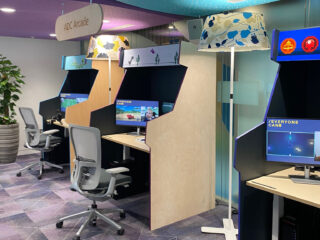
While the immediate purpose of these adaptations is to make gaming more inclusive, they also serve as a powerful demonstration of how assistive technology can transcend entertainment for children and be applied to other spaces – specifically, the workplace. These solutions showcase that accessibility is not only achievable, but also adaptable across different environments. The same technologies that enable disabled people to enjoy gaming could be seamlessly integrated into office environments, creating workplaces where disabled employees can thrive and contribute meaningfully.
For example, the Tobi eye-tracking technology, which allows users to control gaming interfaces with their eyes, can be seamlessly integrated into office systems to allow disabled employees to control their computers, access software or navigate websites using only their gaze.
At Tilting the Lens, we are often approached by clients who want to foster a more inclusive and accessible corporate culture. The innovations I saw at ADC serve as a blueprint for how businesses can embrace this kind of accessibility, transforming not only how we play, but also how we work.
Takeaway 2: AI and emerging technologies offer new opportunities for inclusion, but success requires awareness and then action
No visit to Google’s Accessibility Discovery Centre would be complete without exploring the company’s assistive technologies. From automated captioning and eye tracking to voice control and image recognition, AI-powered tools are ready to change the accessibility landscape. These innovations have the potential to revolutionise the way disabled people interact with the world, adapting interfaces and environments to individual needs in real time.
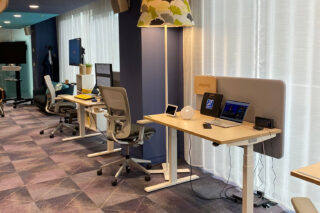
Google Live Transcribe provides real-time transcripts of meetings to ensure that Deaf and hard of hearing people can fully participate, alongside anyone for whom the language being used in the meeting is not their first language. Other examples include Google Voice Access, which allows participants to enter email content, schedule meetings, edit documents and much more using only their voice.
While the promise of AI for accessibility is incredible, it’s not enough. We are entering a new era where technology can act as a great equaliser, but to fully realise this potential, companies must take active steps to invest in these solutions, to have disabled engineers ensure data sets and algorithms are free of ableism, and then integrate them into everyday products and services. Without this commitment, the benefits of these game-changing tools may remain out of reach for those who need them most.
My visit to ADC reinforced a key message: awareness, advocacy and action are essential to drive this momentum forward. It’s not just about developing the technology – it’s about ensuring that businesses and society as a whole understand its importance, are willing to invest in it, and are prepared to make accessibility a priority.
Takeaway 3: Sometimes accessibility is as simple as a pin
One of the first things that struck me during my visit to the ADC was how simple yet powerful accessibility solutions can be. One example is the Social Battery Pin – a small, colourful design element that makes a big difference to Neurodivergent people, as well as those living with anxiety and other mental health conditions, but also to anyone who needs to engage in social environments that can sometimes feel overwhelming.
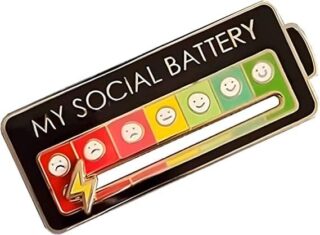
The pin badge can be adjusted to reflect a person’s energy and ability to be social at any given time. This may seem unnecessary to some, but it serves as an important visual cue in the workplace or in public spaces, helping others to understand and respect an individual’s emotional and social boundaries. It works in a similar way to the sunflower lanyard that signals non-apparent disabilities, providing an effective way to communicate accessibility needs without verbalising them.
This experience reinforced an important lesson: accessibility doesn’t always have to be complex. The social battery pin is a reminder that accessibility often comes from empathy and understanding. Sometimes it’s the small, thoughtful details, like this pin, that make the most profound difference to people’s lives.
As consultants, we are often asked to advise on large-scale solutions, but we always emphasise this important principle, especially with clients who are in the early stages of their inclusivity journey. Accessibility can come from simple, intuitive solutions that have a powerful impact on people’s experience, reminding us that sometimes the simplest tools are the most transformative.
Building the world where everyone belongs
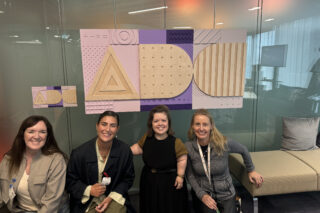
My experience at Google’s Accessibility Discovery Centre has inspired me to continue to champion inclusive design in my role at Tilting the Lens. The Centre’s commitment to building a world where everyone belongs resonates deeply with Tilting the Lens’ mission and the work we do every day asking, “Is this accessible?”. Whether through small, thoughtful solutions or the game-changing potential of AI and technology, many of the tools for inclusion are already with us.
The challenge is to ensure that these solutions are adopted, shared and used at scale. Places like the Google Ireland ADC are shining a light on what’s possible, but it’s up to all of us – consultants, designers, businesses, decision makers and individuals – to make these opportunities a reality. If we can all embrace this mindset of inclusivity, we will truly build a world where everyone belongs.
If you’re ready to take the next step in making your company culture and workforce, product, service or space more inclusive and accessible, we’d love to help you unlock the possibilities. Together, let’s create environments where everyone not only belongs, but thrives.
Other Resources
Beyond function: a conversation on how alt-text becomes art
- Category:
- Past Events
- Webinars
- Format:
- Text
- Video