
Beyond function: a conversation on how alt-text becomes art
Key takeaways from our conversation with Finnegan Shannon
At Tilting the Lens, we focus on discussions that challenge conventional, or outdated, views on accessibility. In the latest episode of our webinar series, “Beyond Function: How Alt-Text Becomes Art”, our CEO and Founder, Sinéad Burke, had the privilege of speaking with Finnegan Shannon. They are an artist whose work reimagines accessibility beyond compliance, infusing creativity, intention, and even joy into the practice of alt-text, disability culture, and inclusive design.
We explore the fascinating journey of “Alt-Text as Poetry” and the significant impact of accessibility in our public spaces. Access isn’t just about functionality—it’s also about being expressive and empowering, allowing everyone to engage and enjoy their surroundings fully.
1. Alt text: more than compliance—it’s an art form
Alt text is a text description of an image or other visual element included in digital formats. One of its main functions is to be read by screen readers, which are used by people who are Blind or low vision. Alt-text is often treated as a box-ticking exercise and something that must be ticked off rather than a feature that enhances the experience of an image.
In 2018, Fin and their collaborator Bojana Coklyat challenged this by creating “Alt-Text as Poetry,” a curriculum designed to shift this mindset. Through workshops, workbooks, and a dedicated website, Fin and Bojana provide resources and exercises to help individuals and organisations approach alt text, not just as a compliance requirement, but as an opportunity for creativity and inclusivity.
Fin on rethinking alt text:
“[It] came from this idea that maybe we can shake people out of this compliance-oriented mindset, if we frame this as a creative writing practice. Also, there’s been a lot of thinking that’s been done in the world of poetry that might be interesting to reference. […] that shows us that you can write something very short and concise that’s also very expressive.”
2. The importance of alt text in digital media
With the European Accessibility Act (EAA) coming into force in 2025, businesses must ensure their digital content is accessible. A 2024 report from WebAIM says that almost 96% of all homepages fail accessibility tests. These errors include not having correct alt text for images. Many websites and social media platforms continue to leave alt text blank or depend on AI-generated descriptions that lack nuance and personalisation. Sinéad, our CEO, founder, and facilitator of this webinar, is incredibly excited about what this means for the future of alt text.
Sinéad on the future of alt text:
“Alt text is becoming a legal requirement, but that doesn’t mean we should aim for the bare minimum. It’s a chance to create a richer, more inclusive internet that truly values disabled users.”
“I think depending on where or who you engage in advice around Alt Text often the instruction is it should be no more than two lines, and it should be succinct and brief. What I have learned in my practice around accessibility is that there is more than one way to create access. And what is accessible for one person, even one person who is blind or screen reader user is not necessarily what another person wants.”
3. Who gets to belong in public spaces?
Fin’s work often highlights the lack of accessibility in museums, galleries, and public institutions. Their well-known installation, “This Exhibition Has Asked Me to Stand for Too Long” draws attention to how spaces are not designed for disabled people to rest and engage fully.
Fin on designing inclusive spaces:
“As I was researching why there aren’t more places to sit, what I was learning is that oftentimes it has to do with curators and ways that they are imaging exhibitions that don’t include places to sit. And I basically realised if I made an art work that was also functional as a place to sit, it was a way of working around that problem. And kind of getting a bench into a space where there might otherwise not be a bench.”
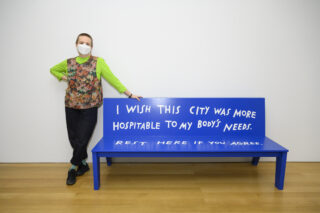
They also reminded us of the personal power we hold and the traditional systems we should question and change.
“I think sometimes it’s easy to forget that all of the spaces that we inhabit are not neutral or inherent. That they embody choices that have been made over and over. And those choices have an ideology.”
4. Reimagining the “selfie”
Fin describes “Alt Text Selfies” as a recent project that evolved from “Alt Text as Poetry” and is also a collaboration with Bojana Coklyat and a third collaborator, Olivia Dreisinger. The project reimagines selfies through a disability lens by encouraging written self-portraits, or “alt text selfies,” that emphasise sensory and emotional experiences. The approach challenges traditional image-centric self-expression and promotes inclusivity, making personal narratives accessible to a broader audience. By framing alt text as poetry, participants are invited to create thoughtful descriptions that reflect their identity and experiences.
Fin on Alt Text Selfies:
“I learned so much from the way that other people describe themselves. Both in terms of strategies for self description but then also I think there’s a really — it can be a really generous social interaction. […] And the idea of a selfie generally is kind of like sharing of a certain type of witnessing or allowing yourself to be witnessed I think is really beautiful.”
5. They push back, we move forward
We are witnessing intensifying anti-DEI efforts in the US and worldwide; art, activism, and access remain crucial tools. In a time where inclusion is under threat, rest, care, and accessibility become acts of defiance. We must amplify narratives that challenge oppression and envision liberated futures. Despite setbacks, joy and collective power endure, showing that resistance is a form of creation, not just survival.
Fin on the future:
“There’s so much bad news. […] I think about the way that medicare is being attacked in the United States. […] It’s so violent. I think for me, the work feels the same. The goal is always liberation for all people everywhere. And we keep moving towards that. And in ways that state structures are failing us, we need to build outside of that. I’m always inspired by mutual aid efforts and free clinics and things like that are showing what’s possible peer to peer. […] I think it’s so hard to process everything that’s happening. Taking it bit by bit and yeah, but I think for me trying not to get distracted from how I ultimately want the world to be.”
What’s Next?
This conversation reminds us that accessibility is more than just function—it is an opportunity for creativity, care, and collective change.
- If you want to read about AltTextAsPoetry.net
- If you’d like to contribute to the Alt-Text Selfies project
- If you would like the opportunity to see Fin’s work in person, take a look at Design and Disability at the V&A in London from June 2025
Thank you to Finnegan Shannon for sharing their insights and expertise and to everyone who attended the webinar. Let’s continue to make access beautiful, expressive, and, most importantly, human.
If you don’t want to miss our next webinar, make sure to sign up to our mailing list.
Other Resources
Accessibility, art, and culture: takeaways from our webinar
- Category:
- Past Events
- Webinars
- Format:
- Text
- Video