
Recommended reading: 12 non-fiction books on disability inclusion
“We don’t know, what we don’t know,” is one of our guiding principles here at Tilting the Lens. We love asking questions and finding answers. And we encourage our clients, partners, and the community at large to approach the world with the same curiosity, creativity and vulnerability. Education is essential to pave the way for action. But where should one start?
Books and audio titles are a great way to broaden your awareness. But disability is still significantly underrepresented in publishing: a 2019 survey found that only 3.4% of characters in children’s books are disabled. What’s more, many of the best-selling books about disability were, until recently, mostly written by non-disabled authors and have potentially been perpetuating harmful stereotypes. However, this is beginning to change, especially in non-fiction publishing.
Below, we have compiled a list of recommended reading about disability, access, and inclusion by disabled authors and allies. From a memoir by the ‘mother of disability rights’ to a sweeping social history of autism, these non-fiction titles are replete with authentic and intersectional disabled voices.
1. Demystifying Disability: What to Know, What to Say, and How to Be an Ally by Emily Ladau
Emily Ladau’s “Demystifying Disability” is an invaluable beginners’ guide to understanding disability and being a better ally to disabled people. With an approachable style and actionable steps, Ladau offers an honest and reassuring primer to the world’s largest minority. From learning about disability history to identifying everyday ableism, Ladau’s practical guide is a great place to start.
2. Being Heumann: An Unrepentant Memoir of a Disability Rights Activist by Judy Heumann with Kristen Joiner
Disabled Americans growing up post-ADA (American with Disabilities Act) are indebted to the work of Judy Heumann. From her childhood on the inaccessible streets of Brooklyn to her leadership of the pivotal Sit-In over Section 504, this candid memoir is as much a story about a civil rights movement as it is about the life of Heumann herself. If you want to understand how far US disability legislation has come – and how far it has yet to go – you should read this memoir.
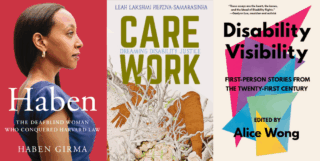
3. Care Work: Dreaming Disability Justice by Leah Lakshmi Piepzna-Samarasinha
In this powerful collection of essays, Leah Lakshmi Piepzna-Samarasinha outlines the politics of disability justice, a movement which centers disabled queer, trans, Black and Brown people. From crip time to anti-capitalism and “collective access,” Lakshmi Piepzna-Samarasinha traces their inspiring vision for building resilient interdependent communities. Crucially, the book centers disabled QTBIPOC perspectives, in a disability movement where white disabled voices still too often dominate.
4. NeuroTribes: The Legacy Of Autism And How To Think Smarter About People Who Think Differently by Steve Silberman
Steve Silberman’s 2015 book “NeuroTribes” is an engrossing social history of autism and neurodiversity. Using fascinating examples from history, science and advocacy, Silberman attests that neurodiversity is not a modern-day phenomenon, but an enduring and essential component of human diversity. For too long, Autistic people have been marginalised and misunderstood. Silberman summons an inclusive world in which neurodiversity is recognised as a beautiful variation of the human brain – and essential for the future of our progress.
5. Sitting Pretty: The View From My Ordinary Resilient Disabled Body by Rebekah Taussig
Rebekah Taussig is a writer, disability advocate and the creator of the Instagram account @sitting_pretty. In this poignant and entertaining memoir-in-essays, Taussig uses personal anecdotes to explain the many impacts of ableism on her life. With humor and vulnerability, Taussig calls for an accessible future in which everyone is welcome and invited.
6. What Can A Body Do? How We Meet the Built World by Sara Hendren
“Disability reveals just how unfinished the world really is, in its mundane forms and in its most aspirational politics,” writes Sara Hendren. This journey into inclusive design will transform the way you perceive the world around you. From the lightbulb moment that led to a disabled woman’s invention of the OXO Peeler, to the use of DeafSpace at the bilingual ASL/English Gallaudet University, Hendren insists that disability is not about deficit: it’s a creative opportunity to build the world anew.
7. Disability Visibility: First Person Stories from the Twenty-First Century by Alice Wong
Activist Alice Wong’s 2020 anthology has quickly become a classic of disability literature. This varied collection of essays by thirty-seven disabled writers offers an authentic and intersectional glimpse into what it means to be a disabled person today. Wong’s introduction alone is an energising call to action to recognise and celebrate disability culture.
8. Crippled: Austerity and the Demonization of Disabled People by Frances Ryan
Following a groundbreaking Paralympics in London in 2012, the UK prided itself on its progressive attitude towards disability. Unfortunately, it wasn’t long before the narrative changed. From politicians’ ableist rhetoric to the harmful narratives being pushed by the media, Ryan investigates how the UK’s disabled people suddenly became the target. Through poignant case studies, Ryan exposes the impact of the last decade of austerity politics on the UK’s 14 million disabled people.
9. Mismatch: How Inclusion Shapes Design by Kat Holmes
According to the World Health Organisation, disability is “a mismatched interaction between the features of a person’s body and the features of the environment in which they live.” Kat Holmes’ “Mismatch” turns this premise into a convincing manifesto on inclusive design. By recognising exclusion and designing with (not for) disabled people, Holmes explains how we can come up with better designs, which benefit everyone. Inclusion is more than a buzzword: it’s ensuring that every member of society can meaningfully participate.
10. Alt Text as Poetry Workbook by Shannon Finnegan and Bojana Coklyat
The “Alt Text as Poetry Workbook” by artists Shannon Finnegan and Bojana Coklyat is a complimentary online resource which includes an introduction to alt text and alt text as poetry, as well as a series of writing exercises. Alt text – which is defined as a “written description of an image posted online” – is a crucial component of web accessibility because it makes visual content accessible to people who are Blind, low-vision or have cognitive disabilities. The workbook encourages writers of alt text to consider its exciting poetic and experimental potential.
11. Accessible America: A History of Disability and Design by Bess Williamson
This detailed history of disability and design tells the untold stories of accessibility and inclusive design from World War II to the present day. From curb cuts to automatic doors and prosthetic limbs, Williamson uncovers the overlooked histories of some of the ubiquitous designs which surround our everyday. Through fascinating examples, she shows that we are not passive onlookers to a built environment: the material world is a place for politics, activism and ultimately, change.
12. Haben: The Deafblind Woman Who Conquered Harvard Law by Haben Girma
This intimate memoir tells the incredible life story of Haben Girma, the human rights lawyer and first Deafblind graduate from Harvard Law School. From her fight to get her college cafeteria to provide accessible menus, to her thriving career in Disability rights, Girma has had to advocate for herself and others all her life. Her memoir is an ode to resilience, creativity and, as she proves time and again, a recognition of disability as an opportunity for innovation.
Find the full list and more recommendations from us at our Bookshop.org.
Other Resources
Beyond function: a conversation on how alt-text becomes art
- Category:
- Past Events
- Webinars
- Format:
- Text
- Video